Off-Plan Property Dubai: The Complete Investor’s Guide 2026
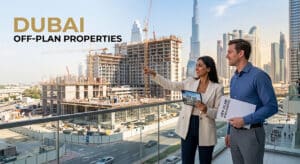
Dubai’s real estate market has been attracting global investors for many years, and at the heart of this is off-plan property Dubai, which has been the top choice for transaction volumes and the dream investment for buyers from around the world. Off-plan sales hit an astonishing AED286 billion ($77.88 billion) in 2025 alone with about 132,000 homes sold, marking the third year in a row that off-plan has led Dubai’s residential market.
But the landscape is changing as we head through 2026. “The market is more discerning, more price-conscious and more focused on long-term value than flippers.” Whether you are a first-time buyer or a seasoned investor, understanding the specifics of off-plan property Dubai in today’s economy is crucial.
What Is An Off-Plan Property?
Off-plan properties are those bought from a developer before they have actually been built. Usually buyers pay through flexible instalment arrangements, with the last payment on handover. This model has become the dominant force in Dubai real estate, accounting for almost 70% of all residential transactions in the last year.
The pitch is simple: you can lock down a home at today’s pricing in a city that keeps on growing, with payment arrangements that make ownership affordable without the requirement for immediate full financing.
Why Off-Plan Property Dubai Is Attracting Investors
1. Flexible payment terms
The payment plan is perhaps the most tempting feature of off-plan property Dubai. Developers are offering schemes like 60/40, 70/30 or even post-handover schedules extending one to three years after completion. Typically constructions are 5-20% deposit on booking with staggered installments linked to development milestones. This basically allows the development to be financed through the bank and your liquidity to be maintained through the construction time.
2. Reducing Entry Costs
Off-plan properties are usually cheaper than completed properties in the same location and hence more affordable to a wider range of customers. Some premium launches may be priced similarly to ready stock, but the payment plan itself replaces the need for bank credit and decreases the opportunity cost of capital during building.
3. Potential for Capital Appreciation
Buying early in the course of a project also means you can sometimes get a lot of appreciation in value by the time you pick up keys – particularly if it’s an area or developer that’s in demand. Early buyers also enjoy first choice of the best layouts, floors and vistas.
4. Features and Facilities of Modern
New buildings include modern layouts, energy-efficient systems, EV-ready parking, smart access features and amenity-rich communities. You’re not just buying a house; you’re buying a lifestyle intended for the future.
5. Effective regulatory safeguards
Dubai has one of the safest legal systems in the world for off-plan real estate. The escrow account system (Law No. 8 of 2007) assures that all funds to the buyer are safely stored and delivered only upon verified construction milestones. The Oqood system registers all off-plan transactions with the Dubai Land Department, establishing your legal stake in the unit before completion.
2026 Market Reality: Being Selective Is Key
Gone are the days of indiscriminate purchase. Dubai’s off-plan market is approaching a more mature phase, with purchasers increasingly focused on price, confidence in delivery, and long-term value.
Off-plan sales during early 2026 reached Dh25.98 billion from 10,623 transactions, up 45% year-on-year. Apartments continue to be the growth driver, accounting for 84 per cent of all off-plan purchases with Dh19.52 billion in value.
But achieved pricing has been about 13% lower, showing a more price-sensitive environment with buyers more scrutinising value. “This is not a distressed market. This is a maturing market.
“We are not at record pricing, but we are not seeing broad-based distress or big discounts. ” Reality is somewhere in the middle.” — Harry Martin, betterhomes
Investor sentiment is also changing. “The past few years were all about short-term gains, but in the current market we’re seeing more buyers thinking five to 10 years out. Just 9% of 2025 off-plan purchases were resales, underlining that most buyers are long-term investors or end-users rather than short-term speculators.
Dubai 2026 Off-Plan Property Hotspots
In particular, demand is focused in a few important areas:
- Jumeirah Village Circle (JVC): Entry-level apartments for about Dh1 million draw investors
- Business Bay: A prime location with high rental demand and potential for capital growth
- Dubai South: Growth corridor, benefits of closeness to Al Maktoum International
- Airport and Expo City Dubai Creek Harbour: Flagship developments with beachfront living and iconic views
- Dubai Islands and Palm Jebel Ali: Premium waterfront developments drawing affluent buyers
Risks to Think About Before Investing
Off-plan property Dubai offers great potential, but it’s not without risks:
Construction Delays
Regulations have improved, but some projects still have delays in construction that may affect your plans if you’re hoping to move in or rent the home by a certain date.
Performance by Developers
Not every developer is up to the same standard. It is crucial to examine their previous initiatives, track record and financial soundness before you sign up.
Market Volatility
Property values can take a hit, especially in market downturns. That’s why you hear more and more about having a long-term investment horizon.
Liquidity Problems
Selling off-plan property before it is finished is not easy. Developers limit resale until a specific percentage of the payment plan is paid, and there are fewer purchasers than for ready residences.
Mitigation actions
How to defend yourself:
- Register the project with the Dubai Land Department.
- All payments should be made through an RERA-approved escrow account.
- Have the SPA checked by a lawyer before you sign.
- Focus on trusted developers with a history of delivery.
Buying Off-Plan Property Dubai: A Step-by-Step Process
- Research Projects and Developers – Compare pricing, yields, and the track record of developers on platforms like DXBinteract.
- Check out the Payment Plan – All payments, service charges and handover requirements are explained.
- Sign the SPA – This documents your rights, timeline and penalty for delays.
- Register with DLD (Oqood) – This protects your ownership rights before completion.
- Monitor Progress — Developers must report building milestones.
- Handover & Final Payment – You get the title deed and keys after completion.
Keep in mind the 4% DLD registration fee and other expenditures when budgeting.
The Long Run Outlook
The fundamentals in Dubai are still very strong. The population is now over 4 million, which increases the underlying housing demand. Historical completion rates estimate actual deliveries could be in the range of 33,000 to 50,000 units, with 2026 expected to provide approximately 110,500 residential units.
The Dubai 2040 Urban Master Plan remains a long-term vision for sustainable development, and the UAE’s economic resiliency and the dirham’s peg to the US dollar make Dubai even more attractive to international investors looking for stability.
Buyers are being more disciplined, completing 132,000 off-plan buys in 2025, accounting for almost two-thirds of all residential transactions, focusing on price, location and long-term demand rather than short-term gains. — betterhomes, Wassim Abdallah
Concluding Remarks
Off-plan property Dubai continues to be among the most attractive real estate prospects in the world, but the game has changed. Research, be selective and have a long-term perspective to be successful in 2026 and beyond. This is no longer just momentum in the market. It is fundamental, quality and confident.
Whether you’re seeking capital appreciation, rental income or a future home, Dubai’s off-plan sector offers a route – if you arrive with your eyes wide open and your due diligence done.
Common Questions
1. Can you buy off-plan property safely in Dubai?
Yes, Dubai has one of the strongest regulatory systems for off-plan real estate in the world. The escrow account mechanism (Law No. 8 of 2007) ensures that funds made by buyers are secured and disbursed only against verified construction milestones. Your legal interest in the unit is formalised via the Oqood registration mechanism with the Dubai Land Department. Recent court decisions have also reinforced investor safety by requiring that proceeds from developer loans be placed in escrow accounts as well.
2. What is the usual payment plan for off-plan property in Dubai?
Payment plans usually begin with a booking deposit of 5-20% and then staggered instalments throughout the construction phase. Typical ratios between construction and handover payments are 60/40, 70/30 and 50/50. Some developers also have post-handover payment options for one to three years following completion. For example, Emaar has staged instalment plans with minimal upfront amounts related to building milestones.
3. Can I sell my off-plan property before it is finished?
Yes, but there are caveats. Off-plan resales are allowed subject to the developer’s and DLD’s regulations. However, some developers don’t allow resale until a particular percentage of the payment plan is paid. Off-plan resales also have a narrower pool of purchasers than ready properties, and you may have to pay transfer fees. By 2025, off-plan resales represented just 9% of all off-plan transactions, showing that most buyers opted to wait until the project was completed.
4. What are the main hazards of buying off-plan property in Dubai?
Primary hazards include construction delays, developer bankruptcy or poor performance, market fluctuations impacting property values, and possible revisions to project requirements. However, these risks are greatly lessened by Dubai’s regulatory structure, including mandatory escrow accounts, DLD project registration, and the Oqood system. Check out the developer’s track record, and get the SPA examined before you sign.
5. Is it now a good time to buy off-plan property in Dubai?
“Right now the market is in a more selective phase, and pricing has recalibrated about 13%. This creates chances for disciplined purchasers who are looking for excellent developments, renowned developers and prime locations. The move toward longer-term investment (five to ten years) instead of short-term speculation indicates that now is a favourable moment for investors who are patient and use a fundamentals-driven strategy.
6. What are the costs connected with off-plan purchases in Dubai?
Key fees include the 4% registration fee with the Dubai Land Department, agent fees (usually 2% of the property value plus VAT) and, if you’re taking a mortgage, possibly a property valuation fee. Service costs and maintenance expenses are also chargeable after transfer. Always include these in your total budget when looking at an off-plan investment.
7. How do I check a developer’s reputation?
Research the developer’s track record by looking at their completed projects, delivery timelines, and quality standards. Use data platforms like DXBinteract to measure developer performance. Check that the project is registered with the Dubai Land Department and that all payments are made through an RERA-certified escrow account. The well-reputed established developers like Emaar, Damac, Nakheel, Sobha and Meraas.
8. What is Oqood registration?
Oqood is the Dubai Land Department’s temporary real property registration. If you buy off-plan, you have to register your Sales and Purchase Agreement with the DLD, and you will be awarded an Oqood certificate. It establishes your legal interest in the unit before completion, enabling authorities to monitor off-plan construction and decreases the chances of conflicts. An unregistered off-plan sale is not enforceable.